Showing posts with label Science. Show all posts

Monday, September 16, 2013

An Introduction


Welcome to the 2013-2014 school year! 

We've really hit the ground running this year, which has been tremendously exciting and gratifying. Unfortunately, it also means that the blog has gotten off to a slow start, even as things in the classroom have taken off. 

Expect more regular updates as we get up to speed (and sign up to have new posts sent to you via email on the right side of this page!).  

For now, here are a few snapshots of what we've been up to over the last two weeks. 


Each week begins with an all-school assembly. Our community continues to grow, and these weekly gatherings keep us connected.  


Our first theme of the year is Explorers of the World. In Science, we've gone back to some of the earliest recorded scientific thought. How can we learn about the nature of the world around us using only our senses and our intellect? 

We had some lovely, sunny days our first week back, and we took advantage of them to do a very old fashioned project. Sam Hirschman introduced us to one of the feats of the pre-Socratic philosopher Thales: While visiting the Great Pyramids in Egypt, Thales was able to accurately calculate their heights by measuring their shadows, then comparing them to the shadows of smaller objects whose heights were more easily measurable. 


We tasked the kids with determining the height of one of the light poles in the S-K parking lot by using the same trick. 

They set about their task by each selecting an object from school to measure, then measuring its height, and its shadow in the afternoon sun: 


We then created a class graph of all of our data, plotting both the height of the objects and the length of the shadow. 


We discovered that there is a linear relationship between our data points, which allows us to calculate the heights of large objects based on the measurements of their shadows. 

It's an activity that has spilled over from Science class into Math, and even a bit into Writing, as we stress the importance of keen observation of details and relationships. 


Rachel discusses digital citizenship with our class

We also spent time last week discussing digital citizenship and responsibility. As you may know, Summers-Knoll has a 1-to-1 laptop program at the middle school level, meaning that each student is assigned their own computer for school use. However, before issuing them, we are working to establish institutional guidelines for their safe and appropriate use. Our students have an active role in the creation of these guidelines, and we've spent time working as a class and in small groups to create a code of conduct. When is Youtube okay to use? Is Minecraft an appropriate use of school time? How private is a school email account? Should other people be able to use your passwords? These are some of the many questions we're navigating as a community entering the online sphere. It's an interesting discussion, and a necessary one. 


We even had our first field trip of the year last week, following the untimely malfunction of the middle school air conditioner on an abnormally hot day. Rather than swelter, we adjourned to the Kelsey Museum of Archeology and the University of Michigan Museum of Art

At the Kelsey, each student selected three artifacts that captured their interest, then wrote a little about each of them. They then placed each item on world history timeline, as well as on a map. 

At the UMMA, S-K Art instructor Monica took us to observe some of the pottery on display, tying in some of the work that has been done in class. 


The first of many class portraits!


We are profoundly lucky to have County Farm Park right across the street from our school. It's a wonderful place to play, study, observe, and contemplate. 


We took an early morning walk last week to discuss a few of its key features: woods, prairie, ponds, and the community farm. Karl also had them playing soccer in the park for PE. It's a fabulous resource and I suspect that we will be regular and frequent visitors! 


Finally, we've already had some class birthdays! It's a bit of a class birthday tradition that the birthday boy or girl gets to choose an activity for the class from a list made by me. It's usually a sizable list of options that includes things like, "Listen to Jason tell stories about the 80s," or "Handwriting Jamboree," but kids always seem to choose the "Recess" option. 

This week, however, we had two birthdays! One student chose recess, while the second chose "watch an episode of 'Star Trek: The Next Generation'." As it turns out, there was a specific episode that I had been planning on screening as a tie-in to our study of the Scientific Revolution. We've been discussing rational thought versus empirical data, so this episode was actually the perfect way to close out a busy Friday afternoon. 

Here's a scene in which an amnesiac Data is skeptical of some pre-industrial age science: 


As a teacher, I recognize, love, and dread that look on Data's face as he skeptically listens to that lecture. 

The kids loved it, and we paused frequently to discuss deduction, logical fallacies, and the fits and starts of developing scientific thought. It even allowed a little discussion about the power of using genre to convey ideas in interesting formats. 


This has only been a taste of what we've been up to! As you can see, we've been busy! I look forward to chatting with you all about the work we've been doing on Curriculum Night! We're off to a great new year! 


Tuesday, May 28, 2013

Spring Trip! DAY 2: Cave City and Mammoth Cave!


After a lovely visit at Serpent Mound, we began our long trip to Cave City, Kentucky. Google Maps says that it's a trip that should have taken us a little over four hours.

Google Maps is a liar.

We drove through torrential downpours, standstill traffic, more torrential downpours, and countless hills and valleys. There were points at which if felt as if we had driven all the way to the Gulf of Mexico. No matter how long we drove, the answer to "HOW MUCH LONGER," was always met with a tired, "about two more hours." This has since become an in-joke, a rallying cry, and an all purpose answer to all manner of questions.

The boys' cabin.
We eventually made it to Jellystone Park Camp, our home for the first two nights. Our amazing crew of parent chaperones called ahead and had a feast of pizza waiting for us, and we let the kids run around exploring together to burn off some of the energy built up by twelve hours spent on buses.

The lights-out portion of the evening went surprisingly well. It was late, and everyone knew we had a long day ahead.

The next morning, the kids rose with the sun, and they were treated to a feast prepared by our all-star parent crew. The parent cabins were equipped with kitchenettes, which were used to make toast, fry bacon, and scramble up several dozen eggs. There was also fresh fruit, yogurt, milk, and juice.

Then we loaded up the buses and headed to Mammoth Cave National Park. The drive from our campsite to the park is peppered with an assortment of local curiosities and attractions (a less charitable person might call them "tourist traps"). If you're planning on visiting Mammoth Cave National Park on a family trip (and I've already heard several rumors of people tentatively planning on returning), make sure to plan some time for bumper boats, the Mystery Spot, and the absolutely terrifying looking "Alpine Slide."

Our first cave tour was called the New Entrance Tour. The brochure sums it up:
New Entrance Tour
A wonderful complement to the Historic Tour, this trip includes a dramatic series of domes and pits, typical large trunk passageways, and a short journey through dripstone formations.
That description really undersells just how amazing it all was! First of all, the "new entrance" means exactly that. The entrance to this part of the cave is manmade, and looks nothing like what you would probably expect:


That utility door that that everyone is entering is the entrance to the cave. It looked much more like something out of the television show Lost than an ancient natural wonder.

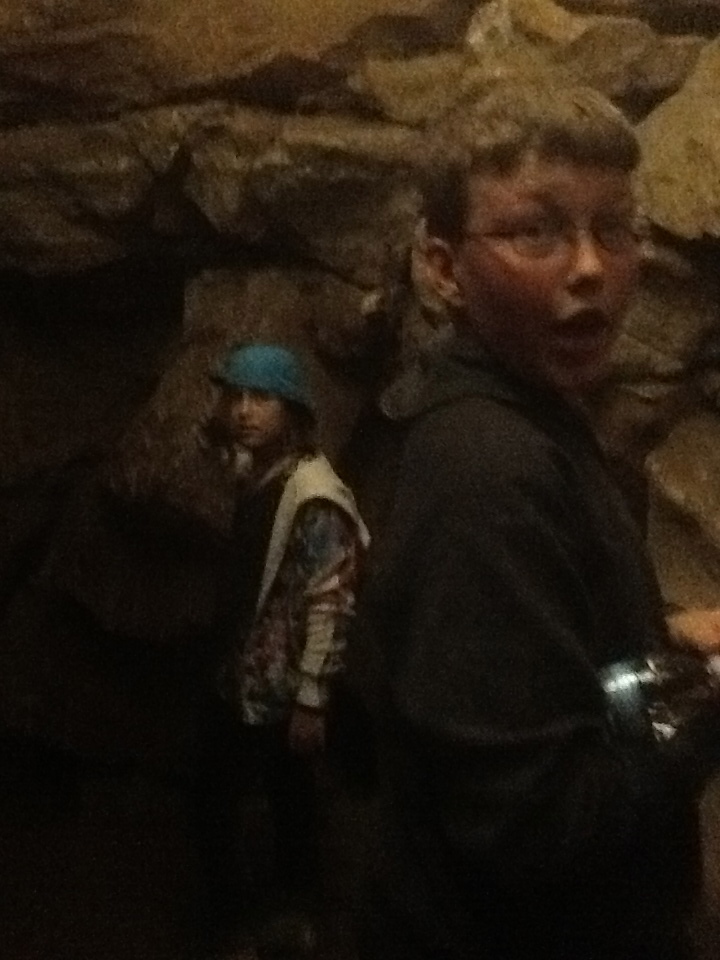
DISCLAIMER: It is really, really difficult to get good photographs in caves. They are very dark, and frequently cramped. Rest assured that the views in person are amazing! The photographs that follow are... less so.

Just through the doorway is a damp, dank, manmade stairway. 

The manmade portion quickly gives way to the cave itself. Stainless steel staircases and walkways twist and turn through the passages. It's really, really cool. 

Aristea and Lev.

Here's a blurry shot of not-much, but if you look closely, you can get a sense of the scale of the interior. 

Again, this may give you a small sense of the scale of the passages. At the top of this photo, you can see a group gathered around a light. At the bottom, you can make out the ghostly silhouettes of people just in front of the camera who are about to climb the stairs.   

People were regularly exclaiming with wonder, pointing, posing, and generally having a wonderful time. Here are Aristea, Denali, and Margaret gathered around a light at a bend in a passageway. 

Each tour features a guide, who made frequent stops to tell us about the science and history of the cave.  We heard a lot about limestone, the sandstone cap (which is the waterproof barrier above the cave), and the colorful human history of the cave.

Following this two-hour excursion, we all enjoyed lunch together in a cafe in the park. Afterwards, Karl took a large group of kids kayaking above ground on the Green River, while I went with a smaller group on a second cave tour. I'll tell you a little about that tour in our next entry!


Spring Trip! Part 1: Serpent Mound


WE MADE IT.

By now, parents, siblings, and families have all probably heard many tales of epic adventure about our Spring trip. Between the parents, teachers, and photo-crazy students, I'm fairly certain that there are well over 11 million photos from this trip. Here are a few highlights from my camera. I'll start with Serpent Mound:

After a long, scenic drive through rural Ohio (and most of Ohio is rural), the kids were ready to run. Here we see them exploring the Serpent (and surrounding areas).


Of course, by "exploring," I mean "picking flowers" and "sinking into mud up to the knee..."

The mound sits on a ridge 100 feet above Ohio Brush Creek. 


A group shot on the observation tower. 


Serpent Mound was a really neat stopping point. It's out of the way (way out of the way), so we essentially had the place to ourselves for the duration of our visit. While there, I picked up a book called Indian Mounds of the Middle Ohio Valley. As it turns out, there are a lot of these mounds spread across Kentucky, Ohio, West Virginia, and Indiana. Serpent Mound is the largest, and generally the most well known. Others can be found on golf courses, in the parks of small towns, or tucked away in subdivisions. These mounds are often subtle, giving little clue that they represent the work of cultures that lived here one thousand years ago. (Artifacts found at Serpent Mound have been dated to 1030 AD.)

After lunch, a tour of the gift shop, and many, many photo ops, we loaded back onto our buses and resumed our long journey to Cave City, Kentucky.


The kids create their own serpent!

Wednesday, May 15, 2013

Seed Bombing


Hi, I’m Noah. I’m in Jason’s 5th grade class, and I have a blog post just for YOU! Yes, you. It’s just for you! On Wednesday, May 1, we went down to the Water Street Redevelopment Project, and we seed bombed it!

If you don’t know what seed bombing is, I’ll tell you. Seed bombing is when you make these little balls made of clay, compost, and whatever seeds you want, and throw them into a field. Mark Maynard, (Clementine's dad) wanted to seed bomb the field because he thought it would
show that the people of Ypsilanti care about their community. 


Making the seed bombs
At first, he decided to just do it with adults and their children, but after some thought, he thought that it would be a good educational experience, so he decided to include schools. His original idea was to seed bomb with sunflowers, but after talking to other people about it, he decided not to, mainly because if the sunflowers roots pick up pollutants, they would have to be treated like hazardous waste. Plus, it’s better to use native plants because they are stronger when in their own environment.

Noah with a slingshot
The tools we used to shoot the seed balls out were our hands, tiny trebuchets, a colossal trebuchet, slingshots, and a snowball thrower.
Some people were kind of violent, throwing them like there are aiming at birds, and others were more subtle. But all in all, everyone loved it! It turns out that your hands are the best for aiming, the snowball throwers sort of worked, the tiny trebuchets failed almost always, and when they did work, that launched it 3 feet away from the curb, and the most efficient was the slingshot, that shot it extremely far, and had amazing aim and precision! The seeds we used (for you horticulturalists out there) are in this link right HERE.The people who made the trebuchets were all in Science Club, and you can check out Dr. G.’s Blog for a little bit about the construction, which is right HERE. The main event took place at 5:00 PM, but I couldn’t show up, but I do have a few pictures from Mark Maynard’s Blog, which is HERE.


Anyway, that’s my blog post. Thank you all for reading! This has been Noah, a new reporter, signing off!

Sunday, February 17, 2013

Matthew summarizes the week

Matthew armed with a new pencil
Hi, this is Matthew, a student of Jason's class, A.K.A The Argonauts. Since October, we have been doing a research papers on ancient civilizations. We are now trying to finish them. Some people had to start over. For example, I am doing the Ancient Greek military. I think that many people are doing very well.

We have also been working on our Place Out of Time stuff. This week on P.O.O.T., we worked on something called a Bio-Cube:
http://www.readwritethink.org/files/resources/interactives/cube_creator/.


Everybody is still trying to keep their own person a secret, and people aren’t succeeding much. So I won’t post my, or anybody else's, person.

In Music, we have been studying The Sphinx Organization, which is an organization for teaching kids without access to music to learn strings. Every year, Sphinx has a competition in musical skills, involving the people that Sphinx taught. We went on a field trip to watch three finalists compete for 1st. The three contestants were Lev Mamuya, Annelle Gregory, and Sterling Elliott. Lev Mamuya got 1st, Sterling Elliot got second, and Annelle Gregory got 3rd. They each got a prize of money; 1st: $5000, 2nd: $3500, and 3rd: $2000.

In Latin, we have been doing what we always have, and for people who don’t know what that is, I’ll fill in the blanks. We translate Latin sentences into English, and take single Latin words and find their English derivatives.

In Science, we are doing things on Digication. Digication is a online portfolio. We are using it to record our calorimetry projects. Here’s the link: http://www.digication.com. We are making a record of what we are doing and a “how to” on the experiment.  


Science Class.


Signing off, 
Matthew  


Thank you, Matthew! 

As Matthew mentioned, we were able to take a school trip (including everyone in grades 3 through 8!) to the beautiful Max M. Fisher Music Center in Detroit on Friday to attend one of the competitions. It was a marvelous opportunity, and we're grateful to Mr. Riccinto for arranging the trip. (Speaking of Mr. Riccinto, have you subscribed to his new music blog yet? If not, check it out!) 
Inside the Max M. Fisher Music Center

While waiting to hear who won, we were treated to a question and answer session. Students were invited to walk up to the stage and ask the conductor questions about Sphinx, the symphony, or anything else that was on their minds. Our own Noah was the first person to rush down to the mic to ask a question, which opened the floodgates of students. I was particularly impressed to see how many Summers-Knoll kids went up to the microphone to take advantage of this unique opportunity. It was a genuine pleasure to be in the company of so many bright, polite, and questioning kids! I was very proud of them on Friday! (Of course, I'm usually pretty proud of them.) 

I hope everyone has a wonderful break!

Friday, January 25, 2013

Jam-Packed January


We've fallen behind a bit with the blog, and it's in part because we've had an extremely busy January! I'll be writing a few catch-up posts over the next few days, and then we'll return to our usual schedule of posting at least once a week. We're also going to be turning some of the posting duties over to the class in the weeks ahead, with each student taking turns to recap our activities for each week.  

Global Citizenship

Our first weeks of 2013 have been packed with activity, much of which has been related to our Global Citizenship theme. This month, we've talked a lot about the unintended consequences that human activity have had on the natural world. We kicked off this conversation early in the month with an activity. 

Students were presented with the following objects: 


- tin can 
- aluminum can
- cotton rag
- wool sock
- styrofoam block
- plastic bottle
- glass bottle
- apple core
- leather boot
- paper bag

They were then asked what they had in common. As you might imagine, there were many clever and ridiculous answers, but the one we finally hit on was that these are all things that are likely to be thrown into the garbage at some point. 

We then split into small groups. Different materials decompose at different rates, and each group was asked to list the items in order from the quickest to decompose to the longest. We then compared our lists on the board: 


After each group gave their rationale for their list, I gave everyone the correct order and asked them to come up with their best guesses for how long it would take for each item to decompose. The answers were eye-opening: 


  1. apple: 3-4 weeks
  2. paper bag: 1 month
  3. cotton rag: 5 months
  4. wool sock: 1 year
  5. leather boot: 40-50 years for the leather, 50-80 for the rubber sole
  6. tin can: 80 years
  7. aluminum can: 200 years
  8. plastic bottle: 1 million years (?)
  9. Styrofoam block: unknown
  10. glass bottle: unknown


Some of this was surprising. For example, Styrofoam seems so fragile and brittle that one might think that it would "break down" quickly. This lead to a discussion on the difference between "biodegradation" and simply breaking something into smaller and smaller pieces. A hunk of Styrofoam may get broken down into smaller and smaller bits, but they are still tiny pieces of Styrofoam. The same is true of plastic.

Another observation that was made was that items that were the least processed by humans were the things that broke down the fastest. Apples, paper, cotton, wool, and leather will break down much more quickly than processed tin and aluminum.

This activity primed them for a conversation about the Great Pacific Garbage Patch, which we talked about a few days later. If you're unfamiliar with the Garbage Patch, take a look at this short video. It's only two minutes long, but it's pretty powerful. It will stick with you.


We also watched a slightly longer video (it's about seven minutes long) of a talk given by Capt. Charles Moore, who first visited the garbage patch and who has worked to publicize its existence.

These videos, along with some readings, have generated many subsequent conversations on a variety of topics. For example, learning about the nature of the garbage patch has introduced the concept of global ocean and atmospheric currents. Understanding how the patch came into existence means learning about these currents, and specifically gyres, which is a term they had previously been unfamiliar with. (There are actually five large garbage patches across the globe, created by five large gyres. The Pacific Garbage Patch is simply the one that has recieved the most media attention.) Each of these concepts introduces potential lines of inquiry for individual research and project work, which we will be developing over the course the school year.


Literature Circles
We've also introduced Literature Circles this month. Every Monday, Wednesday, and Friday, we join with Karl's class to work in small groups. Each group is reading a different novel. Karl has introduced the topic on his class blog here: http://sikkenga.blogspot.com/2013/01/literature-circles.html


Danny, Jonathan, Jianmarco, and Alexandra reading The Absolutely True Diary of a Part Time Indian by Sherman Alexie


Saul, Lily, Kaeli, and Noah reading Red Scarf Girl by Ji-li Jiang


Melissa, Matthew, Cory, and Taylor reading Life As We Knew It by Susan Beth Pfeffer


Denali, Isobel Aristea, and Margaret reading Island of the Blue Dolphins by Scott O'Dell 


Evan, Henry, and Trent reading My Brother Sam is Dead by James Lincoln Collier and Christopher Collier


Karl has also posted some of the questions that the groups have come up with regarding their books. Read his post here


Wednesday, November 28, 2012

Compost Furnace and Read Alouds


Dr. George put the kids to work on loading up the compost furnace for our hoop house earlier this month. Read more about it George's blog.

Checking out the design.

Harvesting the fuel beneath our feet.

Alexandra loading the cart.

Bucket brigade.

Melissa, delighted by hard labor. 

Henry A. putting his back into it. 


On the day before Thanksgiving break, guest reader Karl read to us from Before Columbus, telling us the true story of the man known as Squanto.


As for our regularly scheduled read aloud, we're rapidly reaching the climax of Esperanza Rising, which has introduced the concepts of organized labor, immigration, undocumented workers, the Mexican Revolution, and more. Here are some discussion questions that have come up in class that you might enjoy discussing at home:


Finally, we're off on another field trip this afternoon. We'll be visiting the University of Michigan Museum of Art to explore their African and Asian collections as part of our Ancient Civilizations studies. Ask your student about the trip tonight!